
Leadership Alignment Diagnostic
Is your leadership team as aligned as you think?
Leadership teams can agree in the room—and still leave with different priorities, interpretations, messages, and expectations.
The Leadership Alignment Diagnostic goes beyond asking whether leaders feel aligned. It examines alignment across what leaders believe, prioritize, communicate, decide, and put into practice—revealing where the team is moving together and where differences may be getting in the way.
See What We AssessAlignment Is More Than Agreement
The real question is whether leaders are aligned enough to lead consistently.
A leadership team can have strong individual leaders and still create organizational friction when those leaders interpret direction differently, prioritize competing work, communicate inconsistent messages, or operate from different assumptions.
The diagnostic creates a shared, evidence-based picture of where leadership alignment is strong, where perspectives differ, and where greater consistency may matter most.
What We Assess
Eight dimensions that drive leadership alignment.
Alignment isn't just about agreement. It's about shared understanding and actionable consistency—from organizational direction through execution.
Purpose & Mission
Shared understanding of why the organization exists and what it is working to accomplish.
Vision & Direction
Alignment around where the organization is headed.
Strategic Priorities
Agreement on what matters most and where attention and resources should be focused.
Values & Leadership Principles
Shared expectations about the principles that should guide leadership decisions and behavior.
Decision-Making & Accountability
Alignment around how decisions are made, ownership is established, and accountability is maintained.
Leadership Communication
Consistency in the messages leaders communicate across the organization.
Cross-Leadership Collaboration
Alignment in how leaders work across functions, priorities, and organizational boundaries.
Execution & Follow-Through
Consistency in translating leadership decisions and priorities into coordinated action.
When Leadership Alignment Matters Most
Some moments make alignment especially consequential.
The diagnostic can be used proactively or when signs of misalignment are already visible. It is particularly useful when the organization needs leaders to interpret priorities, make decisions, and communicate with greater consistency.
Welcoming New Leadership
A new CEO, president, or senior leader changes the perspectives and dynamics around the table.
Setting or Resetting Strategy
Determine whether leaders share an understanding of where the organization is going and what matters most.
Navigating Significant Change
Transformation, restructuring, rapid growth, or other major change requires leaders to move in the same direction.
Bringing a New Team Together
Understand where a newly formed or significantly changed team already aligns—and where conversations are needed.
Experiencing Silos or Leadership Friction
Identify where competing priorities, functional perspectives, or different assumptions may be creating disconnects.
Sending Mixed Messages
When employees hear different priorities or expectations from different leaders, uncover what may be driving the inconsistency.
Preparing for Growth
Make sure leadership alignment can support increasing complexity, decisions, and interdependencies.
Checking the Health of an Established Team
Test whether perceived alignment actually matches how leaders think and operate.
From Individual Perspectives to a Shared Picture
See where you align—and where you don't.
Each senior leadership team member completes the confidential diagnostic independently. Advanced HR analyzes both overall alignment and the degree of consistency across leaders, looking for areas of convergence, divergence, and meaningful variation.
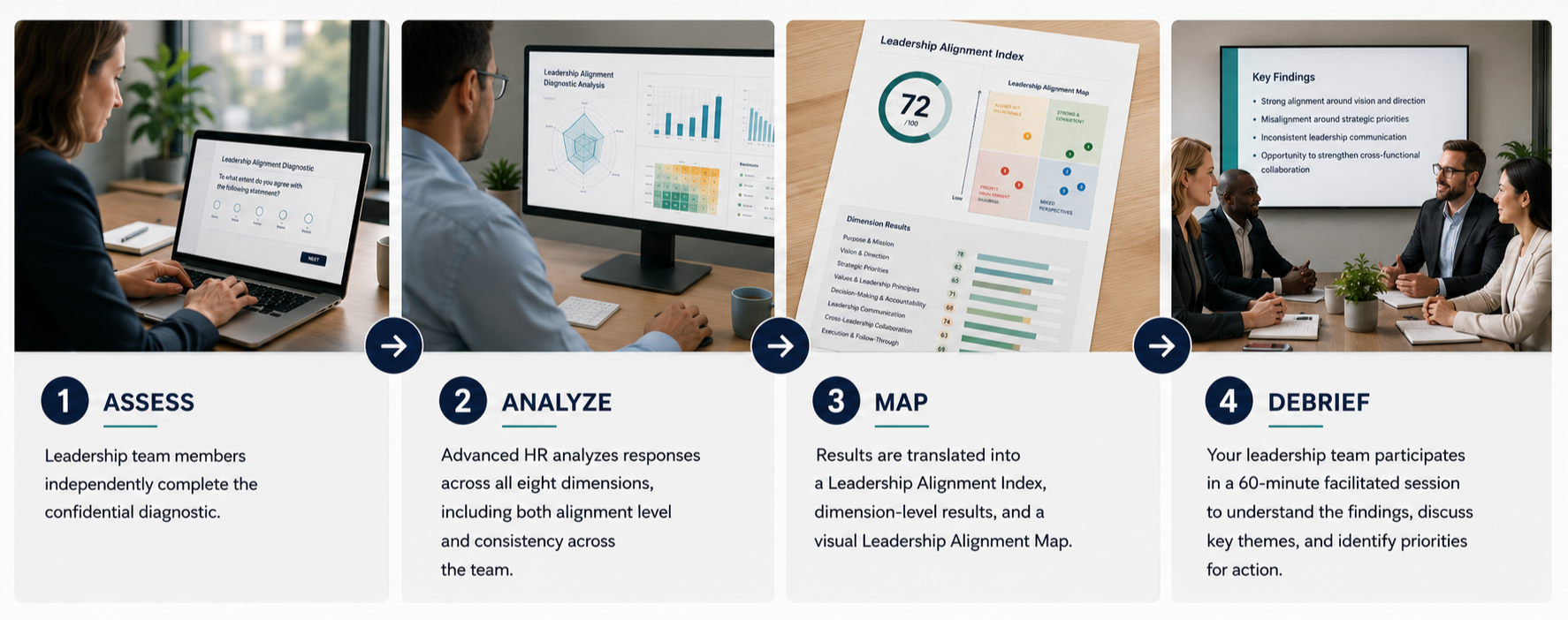
Assess
Leadership team members independently complete the confidential diagnostic.
Analyze
Advanced HR analyzes responses across all eight dimensions, including both alignment level and consistency across the team.
Map
Results are translated into a Leadership Alignment Index, dimension-level results, and a visual Leadership Alignment Map.
Debrief
Your leadership team participates in a 60-minute facilitated session to understand findings, discuss key themes, and identify priorities for action.
What You Receive
Not just a score. A clearer picture of how your leadership team is operating.
Results translate individual perspectives into practical leadership-team intelligence—showing both the level of alignment and how consistently leaders see the organization.
Vulnerable
Consistent
Misalignment
Perspectives
Leadership Alignment Index
An overall view of leadership-team alignment based on proprietary scoring methodology across eight dimensions.
8 Dimension Results
See where alignment is strongest and where greater alignment may be needed.
Leadership Alignment Map
A visual picture of alignment and consistency across the eight dimensions.
Key Findings & Themes
Understand significant patterns, areas of divergence, and themes from qualitative responses.
Benchmark Perspective
Compare results with available data from the Advanced HR Leadership Alignment database.
Recommended Next Steps + Team Debrief
Receive practical priorities for addressing the most important findings and review the results together in a 60-minute facilitated leadership-team session.
Participation & Pricing
Designed for the senior leadership team.
The Leadership Alignment Diagnostic is designed for senior leadership teams of three or more, including the organization's CEO or senior-most leader.
3+ senior leaders The CEO or senior-most organizational leader participates with the leadership team.
Up to 15 participants Standard pricing includes up to 15 participants. Larger leadership teams are available for an additional fee.
Confidential individual responses Individual responses remain confidential. Results are reported at the leadership-team level.
Leadership Alignment Diagnostic
Alignment shouldn't be an assumption.
See where your leadership team is aligned, where perspectives differ, and where greater consistency could strengthen organizational performance.